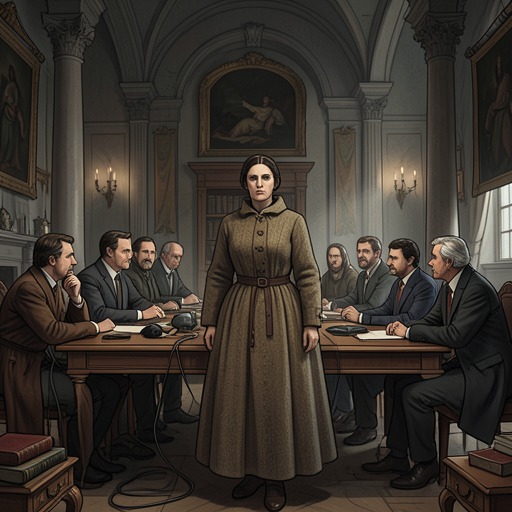
Poisoning and death of Emily Inglethorp
The Mysterious Affair at StylesEmily Inglethorp’s poisoning and death is the central crime of the Styles case and the event that turns a household mystery into a murder investigation. The initial suspicion that she was poisoned in coffee gives way to a more intricate explanation: the strychnine was already in her prescribed medicine, where it settled into a concentrated deposit that she swallowed in the final dose. The delayed timing of that dose, and the evidence left by the attempt to control it, become crucial to the investigation.
The final hours
During Emily’s final attack, those around her are unable to help. John and Mary try to give her brandy, but the convulsions continue. Dr. Bauerstein arrives and attempts artificial respiration, then sends the others from the room; his efforts fail. Before becoming motionless, Emily calls out Alfred’s name. The cry becomes an immediate and consequential clue, but it does not, by itself, establish who poisoned her or how.
At the inquest, John identifies the body and describes waking in the early hours and the circumstances of his mother’s death. A London toxicology specialist reports that the post-mortem confirms strychnine poisoning. The quantity recovered indicates that Emily must have taken at least three-quarters of a grain, and probably about one grain or slightly more. The specialist considers accidental ingestion very unlikely: strychnine is not an ordinary household poison, and its sale is restricted.
Early theories and the timing problem
The initial theory places the poison in Emily’s after-dinner coffee, which Alfred had taken to her. Hercule Poirot frames the issue in terms of timing: the symptoms appeared in the early hours, whereas the coffee was presumably taken at about eight o’clock. Since strychnine ordinarily produces symptoms within one to two hours, and no condition that would delay its action appeared to apply, the interval points to a later source. The cocoa Emily habitually drank in the middle of the night is also tested, but the sample Dr. Bauerstein submits for analysis contains no strychnine.
The inquiry becomes crowded with competing appearances of the poison. Poirot observes that strychnine has surfaced in Emily’s tonic, in the strychnine sold by Mace at Styles St. Mary, and in material handled by someone in the household. The repeated references confuse the case rather than resolve it, because not every trace of poison identifies the fatal route or its author. At the inquest, the jury eventually returns a verdict of wilful murder against a person or persons unknown.
The medicine and the fatal dose
Poirot’s reconstruction resolves the apparent contradiction between the negative cocoa test and the positive post-mortem. He reasons that Emily’s coffee was never drunk and that the cocoa contained no strychnine; a third medium must therefore account for the poison taken between seven and nine in the evening. That medium is her medicine. The strychnine that killed her was the same strychnine prescribed by Dr. Wilkins, not poison newly introduced into the tonic immediately before she drank it.
The explanation depends on the mixture’s chemistry as presented in the novel. Poirot cites a dispensing text describing a similar preparation in which strychnine precipitates over several hours as an insoluble bromide, forming crystals at the bottom of the bottle. In the cited case, the person who took the last dose swallowed nearly all of the accumulated strychnine. Dr. Wilkins’s prescription contained no bromide, but Poirot recalls an empty box of bromide powders: adding one or two powders to the full medicine bottle would cause the strychnine to precipitate. The person who usually poured Emily’s medicine was careful not to shake the bottle, leaving the sediment undisturbed until the final dose concentrated the danger.
This mechanism explains how a poison could be present in the medicine without being evenly distributed through it. It also accounts for why the crucial amount was taken at the end, rather than in an earlier dose. The novel makes pharmaceutical behavior part of the evidentiary chain: the sediment, the unshaken bottle, the timing of the last dose, and the post-mortem quantity combine to explain the death more precisely than the conspicuous coffee theory.
A plan thrown off course
Poirot says that the tragedy was intended for Monday evening. On that day Emily’s bell wire had been neatly cut, while Cynthia was spending the night with friends; Emily would have been alone in the right wing and separated from help. The expected opportunity did not occur. In a hurry to attend a village entertainment, Emily forgot to take her medicine, and the following day she lunched away from home. Her fatal dose was consequently taken twenty-four hours later than the murderer had anticipated.
That delay has two consequences in Poirot’s account. It changes when the poison takes effect, and it gives him the final proof he needs. He produces three strips of paper and identifies them as a letter in the murderer’s own handwriting. The letter’s wording was not clear enough to save Emily: she recognized that she was in danger, but not the means by which that danger would be carried out. The death is thus both the crime the investigation must explain and the point around which its clues become legible: an apparently ordinary medicine, a missed dose, and a plan whose timing fails to match its author’s expectations.